Framework overview#
Pymob is built around pymob.simulation.SimulationBase, which is the object where all necessary information are pooled. For configuration, pymob relies on pymob.sim.config.Config, which uses pydantic to validate the configuration, before it is used to set up the simulation.
from pymob import SimulationBase

# initializing a Simulation with a config file
sim = SimulationBase(config="case_studies/quickstart/scenarios/test/settings.cfg")

# accessing the config file
sim.config
Config(case_study=Casestudy(init_root='/home/flo-schu/projects/pymob/docs/source/user_guide', root='.', name='quickstart', version=None, pymob_version='0.5.3', scenario='test', package='case_studies', modules=['sim', 'mod', 'prob', 'data', 'plot'], simulation='Simulation', output=None, data=None, observations='observations.nc', logging='DEBUG', logfile=None, output_path='case_studies/quickstart/results/test', data_path='case_studies/quickstart/data', default_settings_path='case_studies/quickstart/scenarios/test/settings.cfg'), simulation=Simulation(model=None, solver=None, y0=[], x_in=[], input_files=[], n_ode_states=1, batch_dimension='batch_id', x_dimension='x', modeltype='deterministic', solver_post_processing=None, seed=1), data_structure=Datastructure(y=DataVariable(dimensions=['x'], min=-5.690912333645177, max=5.891166954282328, observed=True, dimensions_evaluator=None)), solverbase=Solverbase(x_dim='time', exclude_kwargs_model=('t', 'time', 'x_in', 'y', 'x', 'Y', 'X'), exclude_kwargs_postprocessing=('t', 'time', 'interpolation', 'results')), jaxsolver=Jaxsolver(diffrax_solver='Dopri5', rtol=1e-06, atol=1e-07, pcoeff=0.0, icoeff=1.0, dcoeff=0.0, max_steps=100000, throw_exception=True), inference=Inference(eps=1e-08, objective_function='total_average', n_objectives=1, objective_names=[], backend=None, extra_vars=[], plot=None, n_predictions=100), model_parameters=Modelparameters(a=Param(name=None, value=0.0, dims=(), prior=None, min=None, max=None, step=None, hyper=False, free=False), b=Param(name=None, value=3.0, dims=(), prior=RandomVariable(distribution='lognorm', parameters={'scale': 1, 's': 1}, obs=None, obs_inv=None), min=-5.0, max=5.0, step=None, hyper=False, free=True), sigma_y=Param(name=None, value=0.0, dims=(), prior=RandomVariable(distribution='lognorm', parameters={'scale': 1, 's': 1}, obs=None, obs_inv=None), min=0.0, max=1.0, step=None, hyper=False, free=True)), error_model=Errormodel(y=RandomVariable(distribution='normal', parameters={'loc': y, 'scale': sigma_y}, obs=None, obs_inv=None)), multiprocessing=Multiprocessing(cores=1), inference_pyabc=Pyabc(sampler='SingleCoreSampler', population_size=100, minimum_epsilon=0.0, min_eps_diff=0.0, max_nr_populations=1000, database_path='/tmp/pyabc.db'), inference_pyabc_redis=Redis(password='nopassword', port=1111, n_predictions=50, history_id=-1, model_id=0), inference_pymoo=Pymoo(algortihm='UNSGA3', population_size=100, max_nr_populations=1000, ftol=1e-05, xtol=1e-07, cvtol=1e-07, verbose=True), inference_numpyro=Numpyro(user_defined_probability_model=None, user_defined_error_model=None, user_defined_preprocessing=None, gaussian_base_distribution=False, kernel='nuts', init_strategy='init_to_uniform', chains=1, draws=2000, warmup=1000, thinning=1, nuts_draws=2000, nuts_step_size=0.8, nuts_max_tree_depth=10, nuts_target_accept_prob=0.8, nuts_dense_mass=True, nuts_adapt_step_size=True, nuts_adapt_mass_matrix=True, sa_adapt_state_size=None, svi_iterations=10000, svi_learning_rate=0.0001), report=Report(table_parameter_estimates=True, table_parameter_estimates_format='csv', table_parameter_estimates_error_metric='sd', table_parameter_estimates_parameters_as_rows=True, table_parameter_estimates_with_batch_dim_vars=False, table_parameter_estimates_override_names={}, plot_trace=True, plot_parameter_pairs=True))
Pymob API#
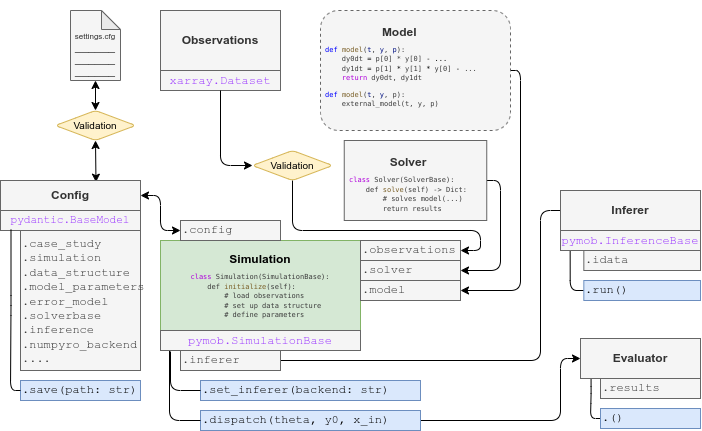
Pymob exposes the following input and output interfaces#
Config#
Pymob uses pydantic Models for validation of the configuration files. The configuration is organized into sections, e.g.
sim.config.data_structure
Datastructure(y=DataVariable(dimensions=['x'], min=-5.690912333645177, max=5.891166954282328, observed=True, dimensions_evaluator=None))
Configurations can be changed in the files before a simulation is initialized from a config file, or directly in the script.
sim.config.data_structure.y.min = 0
print(sim.config.data_structure.y)
dimensions=['x'] min=0.0 max=5.891166954282328 observed=True dimensions_evaluator=None
As can be seen in the figure above, it is the communication between Simulation class and config files is bidirectional, this means, Simulations can be created from config files or in a scripting environment, and successively exported to config files. For more information see configuration for details
Solver#
Solvers solve the model. In order to automatize dimension handling and solving the model for the correct coordinates. Solvers subclass pymob.solver.SolverBase.
sim.solver
Model#
Models are provided as plain Python functions.
sim.model
Observations#
Observations are required to be xarray Datasets. An xarray.Dataset is a collection of annotated arrays, using HDF5 data formats for input/output operations.
Simulation results#
Simulation results are returned by the solver. Plainly they are returned as dictionaries containing NDarrays. However, due to the information contained in the observations dataset, the results dictionary is automatically casted to an xarray.Dataset, which has the same shape as the observations. This makes comparisons between observations and simulations extremely easy.
Parameter estimates#
Parameter estimates are harmonized by reporting them as arviz.InferenceData using xarray.Datasets under the hood. Thereby pymob supports variably dimensional datasets
Parameter estimation#
Parameter estimation is implemented through backends, which can be seen as converters between the pymob.simulation.SimulationBase object and the API of the Inference tool. Inference backends are selected by using
sim.set_inferer("numpyro")
Jax 64 bit mode: False
Absolute tolerance: 1e-07
Supported Algorithms and Planned Features#
Backend |
Supported Algorithms |
Inference |
Hierarchical Models |
|---|---|---|---|
|
Markov Chain Monte Carlo (MCMC), Stochastic Variational Inference (SVI) |
✅ |
✅ |
|
(Global) Multi-objective optimization |
✅ |
plan |
|
Approximate Bayes |
✅ |
plan |
|
Local optimization ( |
dev |
plan |
|
MCMC |
plan |
plan |
|
Simulation Based Inference (in planning) |
hold |
hold |
|
interactive backend in jupyter notebookswith parameter sliders |
✅ |
plan |