Hierarchical Predator Prey modelling#
The Lotka-Volterra predator-prey model is the archetypical model for dynamical systems, depicting the fluctuating population development of the dynamical system. It is simple enough to fit parameters and estimate their uncertainty in a single replicate. But what if there was some environmental fluctuation we wanted
import numpy as np
import arviz as az
import xarray as xr
import matplotlib.pyplot as plt

from pymob import Config
from pymob.inference.scipy_backend import ScipyBackend
from pymob.sim.parameters import Param
from pymob.sim.config import Modelparameters
from pymob.solvers.diffrax import JaxSolver
from pymob.inference.analysis import plot_pair

from lotka_volterra_case_study.sim import HierarchicalSimulation
config = Config("../scenarios/test_hierarchical/settings.cfg")
config.case_study.package = "../.."
config.case_study.scenario = "test_hierarchical"

sim = HierarchicalSimulation(config)
sim.initialize_from_script()
Setting up the data variability structure#
sim.config.model_parameters.alpha_species = Param(
    value=0.5, free=True, hyper=True,
    dims=('rabbit_species','experiment'),
    # take good care to specify hyperpriors correctly.
    # Dimensions are broadcasted following the normal rules of
    # numpy. The below means, in dimension one, we have two different
    # assumptions 1, and 3. Dimension one is the dimension of the rabbit species.
    # The specification loc=[1,3] would be understood as [[1,3]] and
    # be understood as the experiment dimension. Ideally, the dimensionality
    # is so low that you can be specific about the priors. I.e.:
    # scale = [[1,1,1],[3,3,3]]. This of course expects you know about
    # the dimensionality of the prior (i.e. the unique coordinates of the dimensions)
    prior="norm(loc=[[1],[3]],scale=0.1)" # type: ignore
)
# prey birth rate
# to be clear, this says each replicate has a slightly varying birth
# rate depending on the valley where it was observed. Seems legit.
sim.config.model_parameters.alpha = Param(
    value=0.5, free=True, hyper=False,
    dims=('id',),
    prior="lognorm(s=0.1,scale=alpha_species[rabbit_species_index, experiment_index])" # type: ignore
)

# re initialize the observation with
sim.define_observations_replicated_multi_experiment(n=120) # type: ignore
sim.coordinates["time"] = np.arange(12)

# This is a mistake 💥 as we will learn later on ('hierarchical_model_varying_y0.ipynb')
y0 = sim.parse_input("y0", drop_dims=["time"])
sim.model_parameters["y0"] = y0
Small teaser, we define the initial values from the noisy observations! Knowing the true starting values is essential, for correctly fitting the model. But let’s go step by step. In the next part of the tutorial we’ll take a look at varying initial values.
Sample from the nested parameter distribution#
To simply generate some parameter samples from a distribution, the ScipyBackend has been set up.
inferer = ScipyBackend(simulation=sim)

theta = inferer.sample_distribution()

alpha_samples_cottontail = theta["alpha"][sim.observations["rabbit_species"] == "Cottontail"]
alpha_samples_jackrabbit = theta["alpha"][sim.observations["rabbit_species"] == "Jackrabbit"]

alpha_cottontail = np.mean(alpha_samples_cottontail)
alpha_jackrabbit = np.mean(alpha_samples_jackrabbit)

# test if the priors that were broadcasted to the replicates
# match the hyperpriors
np.testing.assert_array_almost_equal(
    [alpha_cottontail, alpha_jackrabbit], [1, 3], decimal=1
)
theta
{'alpha_species': array([[1.03455842, 1.08216181, 1.03304371],
        [2.86968428, 3.09053559, 3.04463746]]),
 'alpha': array([0.98047254, 1.09645966, 1.07297153, 1.06544008, 1.03750305,
        1.09269376, 0.96110586, 1.01784098, 0.98586363, 1.0984052 ,
        1.03867608, 1.00474021, 0.95674713, 1.00828963, 1.03540112,
        1.00643501, 1.17748531, 1.14413297, 0.78887961, 0.85647801,
        2.81996594, 2.75105087, 2.93165267, 2.9327314 , 3.54658756,
        2.56767274, 2.76334393, 3.52006402, 3.06139996, 3.06641263,
        2.72590744, 2.43365562, 2.91814602, 2.90113902, 2.53822955,
        2.68016765, 2.84908431, 2.61098319, 2.84162201, 2.89721612,
        1.08601968, 1.02873671, 1.14836079, 1.18302819, 1.11744581,
        0.99714179, 1.16430687, 1.02923594, 1.18160866, 0.97217639,
        1.18578789, 1.0799928 , 0.95512394, 1.04872042, 1.08803242,
        1.11208858, 0.98092616, 0.96872299, 1.10397707, 1.0328126 ,
        3.16418325, 3.33441202, 2.62076345, 3.17016367, 3.49316814,
        2.9999383 , 2.84984027, 3.33198688, 3.16986518, 3.38019267,
        2.98566599, 2.66488946, 3.0567227 , 2.95577709, 3.33968599,
        3.15096164, 2.62546883, 2.74238532, 3.37610713, 3.30792435,
        0.96897658, 1.03293537, 1.08011429, 1.08258309, 1.12764763,
        1.05988251, 1.02329383, 1.00664669, 1.14807173, 0.82483169,
        1.01881885, 1.03645839, 0.89581139, 1.06800333, 0.96790765,
        1.12609284, 1.02015063, 1.10453543, 1.16695041, 1.07336917,
        2.78935314, 2.61679417, 3.62814045, 3.01094088, 2.84204919,
        3.08887684, 2.98691386, 3.31545894, 3.0549849 , 3.04882659,
        2.83466527, 3.19101371, 2.74558773, 3.2542791 , 3.54584177,
        2.61408264, 2.37918718, 3.23836868, 3.92816193, 2.75464712]),
 'beta': 0.017648710084435453}
Next up we use the samples to generate some trajectories and add Poisson noise on top of the data
sim.solver = JaxSolver
sim.model_parameters["parameters"] = sim.config.model_parameters.value_dict
sim.dispatch_constructor()
e = sim.dispatch(theta=theta)
e()

rng = np.random.default_rng(1)

# add noise.
obs = e.results
obs.rabbits.values = rng.poisson(e.results.rabbits+1e-6)
obs.wolves.values = rng.poisson(e.results.wolves+1e-6)


sim.observations = obs
sim.config.data_structure.rabbits.observed = True
sim.config.data_structure.wolves.observed = True

# update settings
sim.config.case_study.scenario = "test_hierarchical_presimulated"
sim.config.create_directory("scenario", force=True)
sim.config.create_directory("results", force=True)
sim.config.model_parameters.beta.value = np.round(theta["beta"], 4)
sim.config.model_parameters.alpha.value = np.round(theta["alpha"], 2)
sim.config.model_parameters.alpha_species.value = np.round(theta["alpha_species"],2)

# store simulated results
sim.save_observations("simulated_data_hierarchical_species_year.nc", force=True)

# store settings
sim.config.save(force=True)
/home/flo-schu/projects/pymob/pymob/simulation.py:546: UserWarning: The number of ODE states was not specified in the config file [simulation] > 'n_ode_states = <n>'. Extracted the return arguments ['dprey_dt', 'dpredator_dt'] from the source code. Setting 'n_ode_states=2.
  warnings.warn(


Scenario directory exists at '/home/flo-schu/projects/pymob/case_studies/lotka_volterra_case_study/scenarios/test_hierarchical_presimulated'.
Results directory exists at '/home/flo-schu/projects/pymob/case_studies/lotka_volterra_case_study/results/test_hierarchical_presimulated'.
Defining an incorrect error distribution 💥#
To see how to diagnose problems in a model, we deliberately specify an incorrect distribution that looks innocuous, but has two severe problems. One is obvious, the other one is a sneaky one. Below is a conventionally used way to define error models. We center a lognormal error model around the means of the distribution.
sim.config.error_model.rabbits = "lognorm(scale=rabbits+EPS, s=0.1)"
sim.config.error_model.wolves = "lognorm(scale=wolves+EPS, s=0.1)"
sim.dispatch_constructor()
sim.set_inferer("numpyro")
Jax 64 bit mode: False
Absolute tolerance: 1e-07
First we simply try to fit the distribution, but run into a problem, because the lognormal distribution does not support zero values. We get a warning from the check_log_likelihood function from the numpyro backend. If we are unsure if our model is specified incorrectly, it is a good idea to use that function.
try:
    sim.inferer.run()
    raise AssertionError(
        "This model should fail, because there are zero values in the"+
        "observations, hence the log-likelihood becomes nan, because there"+
        "is no support for the values"
    )
except RuntimeError:
    # check likelihoods of rabbits
    loglik = sim.inferer.check_log_likelihood(theta)
    nan_liks = np.isnan(loglik[2]["rabbits_obs"]).sum()

    assert nan_liks > 0
    print(
        "Likelihood is not well defined, there are zeros in the "+
        "observations, while support excludes zeros. "
    )
     Trace Shapes:
      Param Sites:
     Sample Sites:
alpha_species dist   2   3 |
             value   2   3 |
        alpha dist     120 |
             value     120 |
         beta dist         |
             value         |
  rabbits_obs dist 120  12 |
             value 120  12 |
   wolves_obs dist 120  12 |
             value 120  12 |


/home/flo-schu/projects/pymob/pymob/inference/numpyro_backend.py:652: UserWarning: Site rabbits_obs: Out-of-support values provided to log prob method. The value argument should be within the support.
  mcmc.run(next(keys))
/home/flo-schu/projects/pymob/pymob/inference/numpyro_backend.py:652: UserWarning: Site wolves_obs: Out-of-support values provided to log prob method. The value argument should be within the support.
  mcmc.run(next(keys))


Likelihood is not well defined, there are zeros in the observations, while support excludes zeros.


/home/flo-schu/projects/pymob/pymob/inference/numpyro_backend.py:934: UserWarning: Log-likelihoods ['rabbits_obs', 'wolves_obs'] contained NaN or inf values. The gradient based samplers will not be able to sample from this model. Make sure that all functions are numerically well behaved. Inspect the model with `jax.debug.print('{}',x)` https://jax.readthedocs.io/en/latest/notebooks/external_callbacks.html#exploring-debug-callback Or look at the functions step by step to find the position where jnp.grad(func)(x) evaluates to NaN
  warnings.warn(
This problem can be cured by simply incrementing the observations by a small value, but we can go deeper and investigate if the error model is actually a fitting description of the data. For this we generate some prior predictions to look at further problems in the model
idata = sim.inferer.prior_predictions(n=100)

# first we test if numpyro predictions also match the specified priors
alpha_numpyro = idata.prior["alpha"].mean(("chain", "draw"))
alpha_numpyro_cottontail = np.mean(alpha_numpyro.values[sim.observations["rabbit_species"] == "Cottontail"])
alpha_numpyro_jackrabbit = np.mean(alpha_numpyro.values[sim.observations["rabbit_species"] == "Jackrabbit"])

# test if the priors that were broadcasted to the replicates
# match the hyperpriors
np.testing.assert_array_almost_equal(
    [alpha_numpyro_cottontail, alpha_numpyro_jackrabbit], [1, 3], decimal=1
)
Next we plot the likelihoods of the different data variables. This helps to diagnose problems with multiple endpoints
loglik = idata.log_likelihood.sum(("id", "time"))
fig = plot_pair(idata.prior, loglik, parameters=["alpha", "beta"])
fig.savefig(f"{sim.output_path}/bad_likelihood.png")

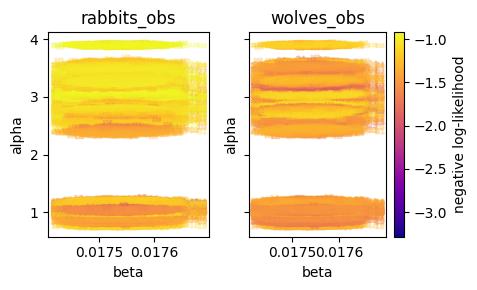
The problem is: due to the large scale differences in rabbits and wolves, the log-likelihoods end up very differently. This has to do with heteroskedasticity. The lognormal density becomes smaller at larger values to maintain the requirement that probability distributions integrate to 1. Here the wolves data variable will basically be meaningless, because the rabbits data variable is at such a high scale Scaling alone also does not resolve this problem, because due to the dynamic of the data variables, larger values will have a higher weight. This is not right. 🤯
Defining a correct error distribution for the data by using a residual error model#
As it turns out, the residuals of a poisson distributed variable can be transformed to a standard normal distributon by dividing with the square root of the random variables mean.
scaled_residuals = (sim.observations - e.results)/np.sqrt(e.results+1e-6)
scaled_residuals.wolves.plot()
<matplotlib.collections.QuadMesh at 0x7fbaaeb69e10>

The heatmap plot shows us that the residual are equally distributed through time and id. This looks perfect. This means there is no underlying dynamic governing the residuals. In pymob, we specify this relationship by providing a transform of the observations of our error model.
sim.config.error_model.rabbits = "norm(loc=0, scale=1, obs=(obs-rabbits)/jnp.sqrt(rabbits+1e-6))"
sim.config.error_model.wolves = "norm(loc=0, scale=1, obs=(obs-wolves)/jnp.sqrt(wolves+1e-6))"

sim.dispatch_constructor()
sim.set_inferer("numpyro")
Jax 64 bit mode: False
Absolute tolerance: 1e-07
idata = sim.inferer.prior_predictions(n=100)

# no nan problems any longer in the likelihood
loglik = sim.inferer.check_log_likelihood(theta)
nan_liks_rabbits = np.isnan(loglik[2]["rabbits_obs"]).sum()
nan_liks_wolves = np.isnan(loglik[2]["wolves_obs"]).sum()
np.testing.assert_array_equal([nan_liks_wolves, nan_liks_rabbits], [0,0])

# plot likelihoods
loglik = idata.log_likelihood.mean(("id", "time"))
fig = plot_pair(idata.prior, loglik, parameters=["alpha", "beta"])
fig.savefig(f"{sim.output_path}/good_likelihood.png")
/home/flo-schu/projects/pymob/pymob/inference/numpyro_backend.py:1033: UserWarning: Cannot make predictions of observations from normalized observations (residuals). Please provide an inverse observation transform: e.g. `sim.config.error_model['rabbits'].obs_inv = ...`.residuals are denoted as 'res'. See Lotka-volterra case study for an example.
  warnings.warn(
/home/flo-schu/projects/pymob/pymob/inference/numpyro_backend.py:1033: UserWarning: Cannot make predictions of observations from normalized observations (residuals). Please provide an inverse observation transform: e.g. `sim.config.error_model['wolves'].obs_inv = ...`.residuals are denoted as 'res'. See Lotka-volterra case study for an example.
  warnings.warn(

Next we look at the problem from a slightly different angle. By splitting the likelihood between different ids (in case of a hierarchical model this is possible, we can look at problematic samples.)
from scipy.stats import norm

# the 2nd visualization is actually not so helpful, because it rather focuses on
# the individual replicates and not so much on the dynamics of the parameters

idata = sim.inferer.prior_predictions(n=100, seed=132)

resid = (idata.prior_predictive.wolves - idata.observed_data.wolves)/np.sqrt(idata.prior_predictive.wolves)
loglik = norm(0,1).logpdf(resid)

idata.log_likelihood["wolves_recompute"] = (("chain", "draw","id", "time"), loglik)

loglik = idata.log_likelihood.sum(("time"))
# prior = idata.prior.rename({"alpha_dim_0":"id"})
fig = plot_pair(idata.prior, loglik, parameters=["alpha", "beta"])
fig.savefig(f"{sim.output_path}/better_likelihood_questionmark.png")
/home/flo-schu/projects/pymob/pymob/inference/numpyro_backend.py:1033: UserWarning: Cannot make predictions of observations from normalized observations (residuals). Please provide an inverse observation transform: e.g. `sim.config.error_model['rabbits'].obs_inv = ...`.residuals are denoted as 'res'. See Lotka-volterra case study for an example.
  warnings.warn(
/home/flo-schu/projects/pymob/pymob/inference/numpyro_backend.py:1033: UserWarning: Cannot make predictions of observations from normalized observations (residuals). Please provide an inverse observation transform: e.g. `sim.config.error_model['wolves'].obs_inv = ...`.residuals are denoted as 'res'. See Lotka-volterra case study for an example.
  warnings.warn(
/home/flo-schu/miniconda3/envs/pymob/lib/python3.11/site-packages/xarray/core/computation.py:821: RuntimeWarning: invalid value encountered in sqrt
  result_data = func(*input_data)

Overall we conclude that it is way better to use residuals for the error modelling, because if the residuals are described correctly, this results in an equally distributed likelihood of the errorrs.
In addition, the reparameterization of the error distribution has seemed to help the NUTS sampler.
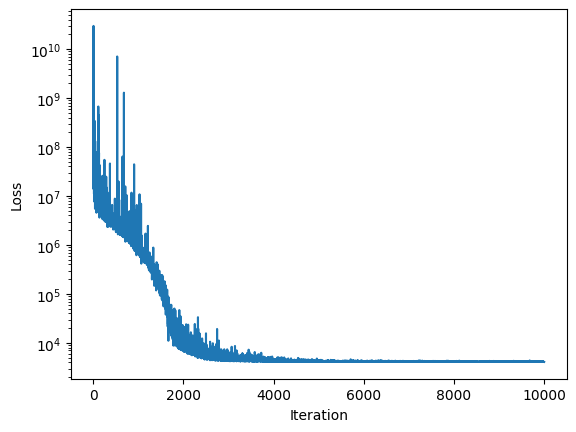
# fitting with SVI seems to work okay
sim.config.inference_numpyro.svi_iterations = 2_000
sim.config.inference_numpyro.svi_learning_rate = 0.005
sim.config.inference_numpyro.gaussian_base_distribution = True
sim.config.jaxsolver.max_steps = 1e5
sim.config.jaxsolver.throw_exception = False
sim.config.inference_numpyro.init_strategy = "init_to_median"
sim.dispatch_constructor()
sim.set_inferer("numpyro")

sample_nuts = True
if sample_nuts:
    sim.config.inference_numpyro.kernel = "nuts"
    sim.inferer.run()
    sim.inferer.store_results() # type: ignore
else:
    sim.inferer.load_results()

idata_nuts = sim.inferer.idata.copy()
az.summary(sim.inferer.idata.posterior)
/home/flo-schu/miniconda3/envs/pymob/lib/python3.11/site-packages/pydantic/main.py:308: UserWarning: Pydantic serializer warnings:
  Expected `int` but got `float` - serialized value may not be as expected
  return self.__pydantic_serializer__.to_python(


Jax 64 bit mode: False
Absolute tolerance: 1e-07


arviz - WARNING - Shape validation failed: input_shape: (1, 2000), minimum_shape: (chains=2, draws=4)
| mean | sd | hdi_3% | hdi_97% | mcse_mean | mcse_sd | ess_bulk | ess_tail | r_hat | |
|---|---|---|---|---|---|---|---|---|---|
| alpha[0] | 0.963 | 0.018 | 0.928 | 0.995 | 0.000 | 0.000 | 3182.0 | 1572.0 | NaN |
| alpha[1] | 1.085 | 0.015 | 1.055 | 1.112 | 0.000 | 0.000 | 3676.0 | 1873.0 | NaN |
| alpha[2] | 1.026 | 0.019 | 0.994 | 1.065 | 0.000 | 0.000 | 2785.0 | 1505.0 | NaN |
| alpha[3] | 1.051 | 0.019 | 1.017 | 1.086 | 0.000 | 0.000 | 3544.0 | 1823.0 | NaN |
| alpha[4] | 1.022 | 0.014 | 0.996 | 1.049 | 0.000 | 0.000 | 3434.0 | 1287.0 | NaN |
| ... | ... | ... | ... | ... | ... | ... | ... | ... | ... |
| wolves_res[119, 7] | 0.159 | 0.135 | -0.088 | 0.420 | 0.002 | 0.002 | 3380.0 | 1368.0 | NaN |
| wolves_res[119, 8] | 0.911 | 0.121 | 0.690 | 1.144 | 0.002 | 0.001 | 3380.0 | 1368.0 | NaN |
| wolves_res[119, 9] | -0.200 | 0.099 | -0.380 | -0.010 | 0.002 | 0.001 | 3380.0 | 1368.0 | NaN |
| wolves_res[119, 10] | 0.179 | 0.087 | 0.021 | 0.347 | 0.001 | 0.001 | 3380.0 | 1368.0 | NaN |
| wolves_res[119, 11] | 0.911 | 0.079 | 0.767 | 1.063 | 0.001 | 0.001 | 3379.0 | 1368.0 | NaN |
6014 rows × 9 columns
az.plot_trace(idata_nuts, var_names=("alpha_species", "beta", "alpha"))
array([[<Axes: title={'center': 'alpha_species'}>,
        <Axes: title={'center': 'alpha_species'}>],
       [<Axes: title={'center': 'beta'}>,
        <Axes: title={'center': 'beta'}>],
       [<Axes: title={'center': 'alpha'}>,
        <Axes: title={'center': 'alpha'}>]], dtype=object)

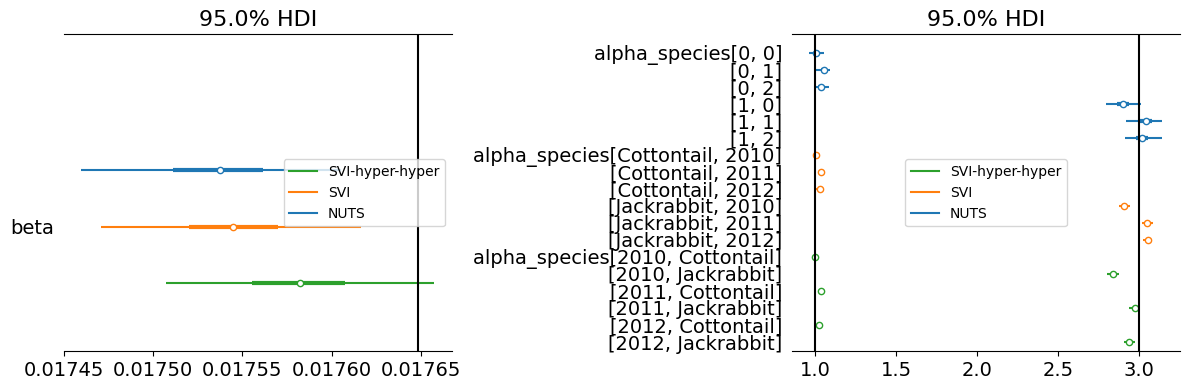
The parameters are perfectly recovered. We have a true beta of 0.1765 and the fitted beta is 0.1755, where the distribution contains the true parameter, although the mode is a bit off. I’m curious if the residual error distribution was too wide or too narrow would have made the posterior beta distribution wider. Also in a second iteration, the priors for estimating should be made less informative, to see if the inference still works. But overall this has been a success. We have no divergences, perfect r_hat and high effective sampling size. So things look good
theta["beta"]
0.017648710084435453
posterior = idata_nuts.posterior[["alpha", "beta"]]
loglik = idata_nuts.log_likelihood.mean(("time"))
fig = plot_pair(posterior, loglik, parameters=["alpha", "beta"])
fig.savefig(f"{sim.output_path}/posterior.png")
Inspect fitted results from MCMC#
# fitting with SVI seems to work okay
sim.config.inference_numpyro.kernel = "svi"
sim.config.inference_numpyro.svi_iterations = 2_000
sim.config.inference_numpyro.svi_learning_rate = 0.005
sim.config.inference_numpyro.gaussian_base_distribution = True
sim.config.jaxsolver.max_steps = 1e5
sim.config.jaxsolver.throw_exception = False
sim.config.inference_numpyro.init_strategy = "init_to_median"
sim.dispatch_constructor()
sim.set_inferer("numpyro")
sim.inferer.run()
idata_svi = sim.inferer.idata.copy()
/home/flo-schu/miniconda3/envs/pymob/lib/python3.11/site-packages/pydantic/main.py:308: UserWarning: Pydantic serializer warnings:
  Expected `int` but got `float` - serialized value may not be as expected
  return self.__pydantic_serializer__.to_python(


Jax 64 bit mode: False
Absolute tolerance: 1e-07
                 Trace Shapes:
                  Param Sites:
                 Sample Sites:
alpha_species_normal_base dist   2   3 |
                         value   2   3 |
        alpha_normal_base dist     120 |
                         value     120 |
         beta_normal_base dist         |
                         value         |
              rabbits_obs dist 120  12 |
                         value 120  12 |
               wolves_obs dist 120  12 |
                         value 120  12 |


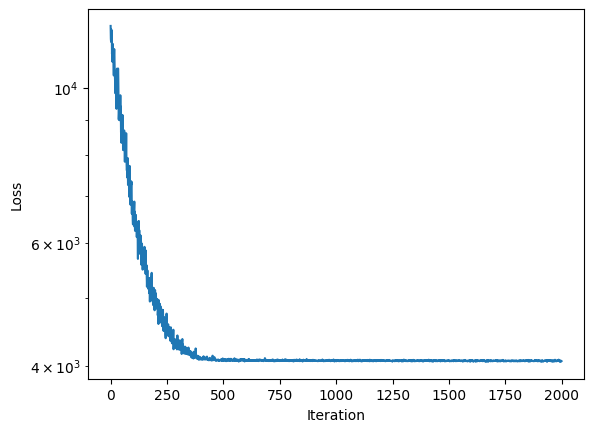
100%|██████████| 2000/2000 [00:24<00:00, 82.05it/s, init loss: 12252.5215, avg. loss [1901-2000]: 4062.4299]
/home/flo-schu/projects/pymob/pymob/inference/numpyro_backend.py:1033: UserWarning: Cannot make predictions of observations from normalized observations (residuals). Please provide an inverse observation transform: e.g. `sim.config.error_model['rabbits'].obs_inv = ...`.residuals are denoted as 'res'. See Lotka-volterra case study for an example.
  warnings.warn(
/home/flo-schu/projects/pymob/pymob/inference/numpyro_backend.py:1033: UserWarning: Cannot make predictions of observations from normalized observations (residuals). Please provide an inverse observation transform: e.g. `sim.config.error_model['wolves'].obs_inv = ...`.residuals are denoted as 'res'. See Lotka-volterra case study for an example.
  warnings.warn(
arviz - WARNING - Shape validation failed: input_shape: (1, 2000), minimum_shape: (chains=2, draws=4)


                                  mean     sd  hdi_3%  hdi_97%  mcse_mean  \
alpha[0]                         0.969  0.017   0.937    1.001        0.0
alpha[1]                         1.083  0.016   1.054    1.114        0.0
alpha[2]                         1.025  0.019   0.990    1.061        0.0
alpha[3]                         1.048  0.018   1.015    1.081        0.0
alpha[4]                         1.021  0.015   0.993    1.048        0.0
...                                ...    ...     ...      ...        ...
alpha_species[Cottontail, 2012]  1.028  0.011   1.008    1.048        0.0
alpha_species[Jackrabbit, 2010]  2.908  0.018   2.876    2.943        0.0
alpha_species[Jackrabbit, 2011]  3.047  0.017   3.015    3.081        0.0
alpha_species[Jackrabbit, 2012]  3.054  0.014   3.028    3.081        0.0
beta                             0.018  0.000   0.017    0.018        0.0

                                 mcse_sd  ess_bulk  ess_tail  r_hat
alpha[0]                             0.0    1972.0    2046.0    NaN
alpha[1]                             0.0    1947.0    1450.0    NaN
alpha[2]                             0.0    2097.0    2004.0    NaN
alpha[3]                             0.0    1710.0    1655.0    NaN
alpha[4]                             0.0    2039.0    1962.0    NaN
...                                  ...       ...       ...    ...
alpha_species[Cottontail, 2012]      0.0    1901.0    1717.0    NaN
alpha_species[Jackrabbit, 2010]      0.0    1864.0    1915.0    NaN
alpha_species[Jackrabbit, 2011]      0.0    1940.0    1961.0    NaN
alpha_species[Jackrabbit, 2012]      0.0    2105.0    1931.0    NaN
beta                                 0.0    2032.0    1961.0    NaN

[127 rows x 9 columns]
posteriors = xr.combine_by_coords([
    idata_svi.posterior.expand_dims("algorithm").assign_coords({"algorithm": ["svi"]}),
    idata_nuts.posterior.expand_dims("algorithm").assign_coords({"algorithm": ["nuts"]}),
    ], combine_attrs="drop"
)
posteriors
<xarray.Dataset>
Dimensions:                          (chain: 1, draw: 2000, alpha_dim_0: 120,
alpha_normal_base_dim_0: 120,
alpha_species_dim_0: 2,
alpha_species_dim_1: 3,
alpha_species_normal_base_dim_0: 2,
alpha_species_normal_base_dim_1: 3,
id: 120, time: 12,
rabbits_res_dim_0: 120,
rabbits_res_dim_1: 12,
wolves_res_dim_0: 120,
wolves_res_dim_1: 12, algorithm: 2,
rabbit_species: 2, experiment: 3)
Coordinates: (12/19)
chain (chain) int64 0
draw (draw) int64 0 1 2 3 … 1997 1998 1999
alpha_dim_0 (alpha_dim_0) int64 0 1 2 3 … 117 118 119
alpha_normal_base_dim_0 (alpha_normal_base_dim_0) int64 0 1 … 119
alpha_species_dim_0 (alpha_species_dim_0) int64 0 1
alpha_species_dim_1 (alpha_species_dim_1) int64 0 1 2 … …
wolves_res_dim_1 (wolves_res_dim_1) int64 0 1 2 … 9 10 11
algorithm (algorithm) <U4 ‘nuts’ ‘svi’
rabbit_species (rabbit_species) <U10 ‘Cottontail’ ‘Jack…
experiment (experiment) <U4 ‘2010’ ‘2011’ ‘2012’ rabbit_species_index (id) int64 0 0 0 0 0 0 0 … 1 1 1 1 1 1 1 experiment_index (id) int64 0 0 0 0 0 0 0 … 2 2 2 2 2 2 2 Data variables: alpha (algorithm, chain, draw, alpha_dim_0, id) float32 … alpha_normal_base (algorithm, chain, draw, alpha_normal_base_dim_0) float32 … alpha_species (algorithm, chain, draw, alpha_species_dim_0, alpha_species_dim_1, rabbit_species, experiment) float32 … alpha_species_normal_base (algorithm, chain, draw, alpha_species_normal_base_dim_0, alpha_species_normal_base_dim_1) float32 … beta (algorithm, chain, draw) float32 0.01757… beta_normal_base (algorithm, chain, draw) float32 -1.297 … rabbits (algorithm, chain, draw, id, time) float32 … rabbits_res (algorithm, chain, draw, rabbits_res_dim_0, rabbits_res_dim_1) float32 … wolves (algorithm, chain, draw, id, time) float32 … wolves_res (algorithm, chain, draw, wolves_res_dim_0, wolves_res_dim_1) float32 …